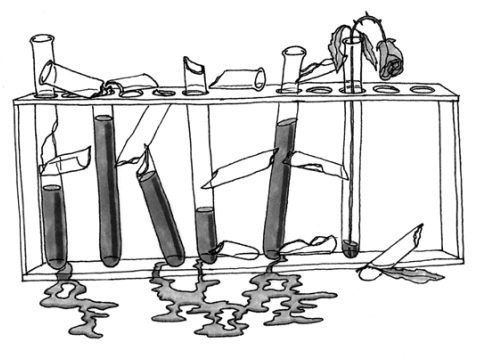
“Much of what we think of as perceptions of the world are really educated guesses based on past experiences (“The fractal pattern of little green bits in my visual field must be a tree”), and this kind of conventional thinking serves us well (Pollan, 2015).”
______________________________________________________________________________
“I don’t think this is the right time” I explain to my father on the phone. “Maybe this summer.” Once again, I was asked if I would like to visit my extended family in Buenos Aires. And once again, I want to turn it down.
“People can only empathize so far,” I think to myself. “At a certain point, we meet a threshold of subjective locked doors.”
I hear a resounding “no” from the back of my mind. It is automatic, rapid, and certain. I know that it is simply not worth it.
The anxiety and indecisiveness this simple question produces overwhelms me. Fears that permeate my every day life get projected onto the vision of this potential future. Fears of being out of control, fears of rejection, and fears that my brain might fall apart.
“At a certain point, we cross a threshold into subjective unknowns” I think to myself again. At a certain point, they can only understand so much. It is a threshold where reason no longer matters…
I am sitting at a brown, wooden desk distributing the evening medication. Mark comes into the room. His shaggy grey goatee hangs uncomfortably off of his chin. Scabs and weeks old pieces of food are attached to the flaky skin below his lips. The wafting smell of an old basement radiates off of his body. Mark has not showered in five years.
I hand him a cup of water. “I can’t drink that” he whispers to me. “Mark. We just went through this two hours ago.”
“I can’t.”
“Why not?” I ask although I know what the response will be.
“I’ll get the runs!” He replies wide eyed and deadly serious.
“And?”
“And then I’ll have to use the bathroom”
“And?” I ask again.
He looks at me with his sharp blue eyes and mucous crusted eyelashes. He gently presses his eye glasses towards his brows. He does it again. And again. He starts caressing his shaggy, grey goatee. Dandruff and crust fall from his chin to the table.
“And?”
“I can’t” he whispers. “It’s just water, right?”
“Just water…You need to drink the water – 64 ounces a day. Do you want another catheter?”
For weeks he had refused to use the toilet to the point that his bladder exploded. Somehow his body has repaired itself.
Mark has recently refused to drink water. We have to use sticks to break up his cemented feces so that it could move down the pipes.
He takes a deep breath and slowly reaches out to grab the cup.
4 inches away. 3 inches. 2. He pulls his hand back to his body and waddles from side to side. “I can’t.”
“At a certain point, we cross a threshold into subjective unknowns” I think to myself again. “At a certain point, we can only understand so much. It is a threshold where reason no longer matters…”
I see the sadness on my Grandmothers face because I make the conscious choice to not see her. 84 years old and coming close to the end; I choose to stay home. I have not seen my cousins in years. I have the time and I have the money. And I choose to stay home. And I continue to hear a resounding “absolutely not.”
My brother chose to be with them. I do not.
How could she possibly understand?
“Nothing got into the water?”
“Have you seen anything go into the water?”
“I don’t think so” he says uncertainly.
“Have you ever found anything in your water?”
“No.” Waddling side to side, he presses his eye glasses up toward his brows – three times.
Finally, with apparent resolve, he reaches out to grab the cup. 4 inches away, 3 inches, 2. He pulls his hand back. “I can’t.”
It has been 20 minutes.
I am choosing safety over risk.
I end up producing the anxiety that I try to avoid. I reinforce my self-fulfilling prophesies. I confirm the stories I continuously and endlessly tell myself. And I continue to avoid what I fear. The irony is inescapable.
Predictions, algorithms, and heuristics have been set firmly in my brain. I know what is safe and I know what is dangerous.
- Anxiety causes dissociation.
- Dissociation causes terror.
- Places where I cannot leave immediately causes anxiety.
“Why not?” I ask myself again. “I just can’t” is all that I can muster.
“But they are your family” I tell myself again.
“I can’t.”
“If I drink the water, I get hydrated. But if I get hydrated, I have to use the bathroom. It’s a catch 22” he expresses mournfully.
We look at each other and for a moment it seems as if he could see the absurdity of his fears. I even think he is about to laugh.
“It is safe” I repeat again. “You will be okay.”
“How do you know?”
“Zach, you will be fine if you go” I say to myself.
“How do you know?” It always seems to come back. It is waiting like a vulture. Sinisterly picking the pristine opportunity to take over. “Why risk it?”
“Mark.” I pause. “I don’t know. We never know. Somehow, we need to learn to trust.”
But I ask myself how he can do this when everything in his subjective reality says otherwise.
“Mark” I pause again. “I know this may sound surprising, but you and I, I do not think we are as different as it seems on the surface”
I look at his worn out face and know that he may never feel much better. Somehow, some of us live in this world with the ability to trust what we see, hear, smell, touch, and interact with. Most of us grow up certain that the person next to us exists; certain that semen are not floating in our water; certain that we will be able to cope with life’s tribulations; certain that we can mostly trust our thoughts and senses. Faith is one of life’s greatest blessings and it almost always goes unnoticed. Our brains make meaning out of chaos and we somehow feel enough certainty to trust what it creates.
I sit on this day solid, present, and grounded. Somehow, this day, my brain trusts what it sees. But somehow, this day, his brain does not.
“Will you try to drink the water?” I ask
“I can’t”
“I can’t go” I say to my father. “If I go, it might come back.”
Side to side, he waddles indecisively. He presses his eye glasses up toward his brow – three times.
He reaches to grab the glass and pulls his hand back. He reaches and pulls back. Reaches. Pulls back.
I want to go. I can’t. I want. I can’t.
Citation:
Pollan, M. (2015, February 9th). The Trip Treatment. The New Yorker
 Zach Rausch